7 Steps to Find the Perfect Meme Coin Entry Without Chasing the Pump
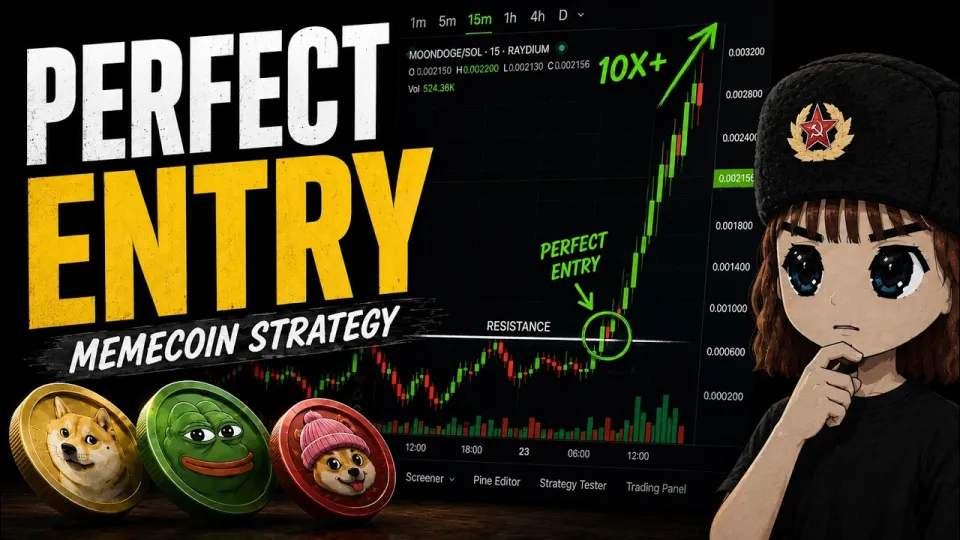
Video: How I Find the PERFECT Entry on Memecoins 📈 (Full Strategy)
Need articles like this for your video? They help promote it on YouTube and Google — order them in the Telegram bot @sat_sit_bot. Articles with your video embedded are written and posted by the bot itself — on popular topical sites (no ads). Try it free: 50 articles on us.
· based on the channel starwifpump
Meme coin trading is mostly an entry-timing problem: the coin choice matters less than where you buy, because the same token can be a great trade at support and a terrible one at the top of a vertical candle. A workable meme coin entry means waiting for chart structure, volume confirmation and a pullback that lets you define risk in advance — and skipping the trade when those conditions are absent. The full process is broken down by the starwifpump channel in its strategy video, and the early-access trading toolkit referenced there is available through the Plasma Telegram group.
Why the entry matters more than the coin in meme coin trading
A meme coin can double your position or cut it in half within minutes, so the distance between your entry and your invalidation level defines the entire trade. Traders who buy a green candle in the middle of a vertical move carry the widest possible stop and the smallest possible upside; traders who wait for a pullback to a defined level carry a tight stop and a much larger target. That asymmetry, not the narrative, is what produces a repeatable edge.
Practical consequences of this framing:
- The same token offers different risk-to-reward depending on the minute you enter.
- A late entry converts a good idea into a bad trade, because the stop has to sit far below price.
- Missing a move costs nothing; entering at the wrong price costs capital and attention.
- A written plan before the click is the only thing that separates a process from a gamble.
Step 1 — Read the chart structure before you look at anything else
Structure is the skeleton of the setup: a chart is tradeable when price is making higher lows, holding a range, or reclaiming a level it previously lost. On a fresh meme coin chart, start on the shortest timeframe that still shows readable swings, mark the obvious horizontal levels, and identify whether the last move was impulsive (one long candle with little overlap) or constructive (a series of steps).
A simple checklist before any further analysis:
- Mark the launch high and the first meaningful consolidation box.
- Draw horizontal support at the base of that box and at the prior swing low.
- Note whether each pullback held above the previous one — that is the definition of an uptrend.
- Discard the chart if price is chopping inside a wide, undefined range with no clean level to lean on.
If you cannot point to the exact price where your idea is wrong, the chart is not ready.
Step 2 — Confirm momentum with volume, not with candle size
Momentum in a meme coin is real when volume expands alongside price and the move holds its gains on the retest. A single enormous candle on thin liquidity is not momentum — it is a liquidity event that frequently reverses. Look for expanding volume on the impulse, contracting volume on the pullback, and a fresh burst of volume when price pushes through the prior high.
Useful momentum markers:
- Volume on the breakout candle exceeds the average of the previous several candles.
- Price closes near its high rather than printing a long upper wick.
- The retest of the broken level happens on lower volume than the breakout itself.
- Social and on-chain activity grows with price instead of lagging behind it.
This is also where most FOMO damage happens: the biggest candle on the screen is usually the worst place to buy, because everyone who wanted in has already bought.
Step 3 — Wait for the pullback into support or a reclaimed level
The highest-quality entries come from pullbacks into a level that has already proven itself — a broken resistance now acting as support, the top of the previous consolidation box, or a moving average that has been respected throughout the move. The pullback gives you a defined invalidation point a few percent below entry and a target back at the recent high, which is the entire basis of a favourable risk-to-reward ratio.
How to execute it:
- Identify the level before price returns to it, so you are not improvising in real time.
- Wait for the candle to actually reach the zone rather than buying on the way down.
- Look for a reaction — a wick into the level with a close back above it, or a small higher low inside the zone.
- Enter with a stop just below the level that produced the reaction.
If price never pulls back, you simply do not get an entry. That is an acceptable outcome, not a missed opportunity.
Step 4 — Separate a healthy retrace from a broken chart
Not every dip is an entry. A pullback is healthy when it is shallow relative to the impulse, happens on declining volume, and holds above the last higher low. It is a warning when it retraces most of the move, accelerates on rising volume, or slices through the level you intended to trade from.
Signals that tell you not to enter:
- Price loses the level that defined your setup and cannot reclaim it on the next candle.
- Volume spikes on the way down rather than on the way up.
- The chart prints a long upper wick followed by a series of lower highs.
- Liquidity is so thin that a normal-sized order moves the price several percent.
- The narrative has already gone mainstream and the chart is a straight vertical line.
Any one of these is enough to stand aside; the setup can always rebuild later.
Step 5 — Plan risk, exits and profit-taking before the click
Risk planning on a meme coin is done in numbers, not in feelings: decide the invalidation level, the position size that keeps a full loss survivable, and the levels where you take profit. A common structure is to scale out into strength — for example, selling a portion into the prior high, another portion into an extension, and letting a remainder run with a trailing stop.
A practical template:
- Invalidation: the price below which your idea is simply wrong.
- Position size: small enough that hitting the stop does not change your week.
- First target: the recent high or the next obvious liquidity pocket.
- Partial exits: fixed percentages taken at pre-marked levels rather than on impulse.
- Trailing rule: a defined mechanism for moving the stop once the trade is in profit.
Writing these down before entry is what stops a losing trade from turning into a hold-and-hope position.
Step 6 — Answer the questions beginners ask most about meme coin entries
Beginners tend to raise the same practical doubts, and they are worth addressing directly. The first is timeframe: very short charts on a brand-new token are noisy by nature, so structure reads better once a few hours of trading exist and levels have been tested more than once. The second is chain choice — the mechanics of structure, volume and pullbacks are the same across Solana, Ethereum and newer ecosystems, but liquidity depth and execution speed differ, which changes how tight a stop can realistically be.
The third recurring question is about tools and filters: trackers and terminals are useful for surfacing candidates, but a screener cannot tell you whether a chart has a clean level to lean on, so the chart read stays with you. The fourth is emotional — traders who lost money on meme coins often lost it by entering at the top of a pump, and the fix is procedural rather than motivational: fewer trades, written plans, and a hard rule against buying a vertical candle.
Step 7 — Build a repeatable routine instead of chasing individual calls
The end goal is a process you can run every day: scan for candidates, mark levels, wait for a pullback into a level, size the position, and execute the pre-written exit plan. Repetition is what turns entry timing from intuition into a checklist, and a checklist is what keeps you out of the trades that ruin accounts.
A daily routine that supports this:
- Review charts you already marked and note which levels held.
- Add new candidates only when a clear structure exists.
- Set alerts at your levels instead of watching every candle.
- Journal each entry with the reason, the invalidation and the outcome.
- Review the journal weekly to see which setups actually pay.
Useful links
- Plasma Telegram — early access, updates and setup help
- Discord community
- Padre terminal VIP access
- Solpump
- starwifpump on X
Final takeaway
Meme coin entries are won before the trade is placed: structure first, volume confirmation second, a pullback into a real level third, and a written risk plan last. The starwifpump channel makes the same point in its full strategy breakdown — most traders do not lose because they picked the wrong coin, they lose because they bought the candle instead of the level. Keep the checklist short, skip the setups that fail it, and let the process rather than the pump decide when you click. For the tooling side of that process, early access and setup help are available through the Plasma Telegram group.
Key takeaways
- Most meme coin losses come from timing the entry wrong, not from picking the wrong ticker.
- A valid setup needs structure first: higher lows or a reclaimed level, not a vertical green candle.
- Momentum is confirmed by volume expansion and follow-through, not by the size of the last candle.
- Pullbacks to broken resistance or the prior consolidation zone give better risk-to-reward than the top of a pump.
- Pre-defined invalidation and exit levels are set before the trade, not after price moves against you.
Questions & answers
What is the best timeframe to analyse a meme coin entry on?
Use the shortest timeframe that still shows readable swings and at least one tested level. On a brand-new token this usually means waiting a few hours until price has formed a visible consolidation box; below that, candles are mostly noise and every wick looks like a signal.
Do the same entry rules work on every chain?
The mechanics are identical everywhere: structure, volume expansion, a pullback into support and a pre-defined invalidation. What changes is liquidity depth and execution speed, which affect how tight a stop can realistically sit without being swept by normal volatility.
How do I avoid FOMO when a coin is already pumping?
Accept in advance that you will miss most vertical moves, because the top of a pump is the worst risk-to-reward entry available. Set alerts at levels you marked earlier, and treat a missed move as a zero-cost outcome rather than a loss.
How much should I risk on a single meme coin trade?
Size the position from the distance to your invalidation level, not from how confident you feel. A practical rule is that a full stop-out should not meaningfully change your week, which typically means risking a small single-digit percentage of the account per trade.
Source: How I Find the PERFECT Entry on Memecoins 📈 (Full Strategy) · Markdown version